

A guide to weight, fit and safe packing
School bags have a habit of becoming mobile cupboards. Books and stationery are joined by laptops, chargers, lunches, water bottles, PE kits and all the bits and pieces that quietly collect during the week. None may seem especially heavy on its own, but together they can create a surprisingly demanding load for a child to carry.
A heavy or poorly fitted bag can be uncomfortable and may change the way a child stands or walks while carrying it. It can also contribute to pain around the shoulders, neck or back. The good news is that a few practical changes to the bag, its contents and the way it is worn can make the school journey considerably more comfortable.
This guide explains how heavy a school bag should be, what a good fit looks like, how to pack it and the signs that suggest something needs to change
The quick answer
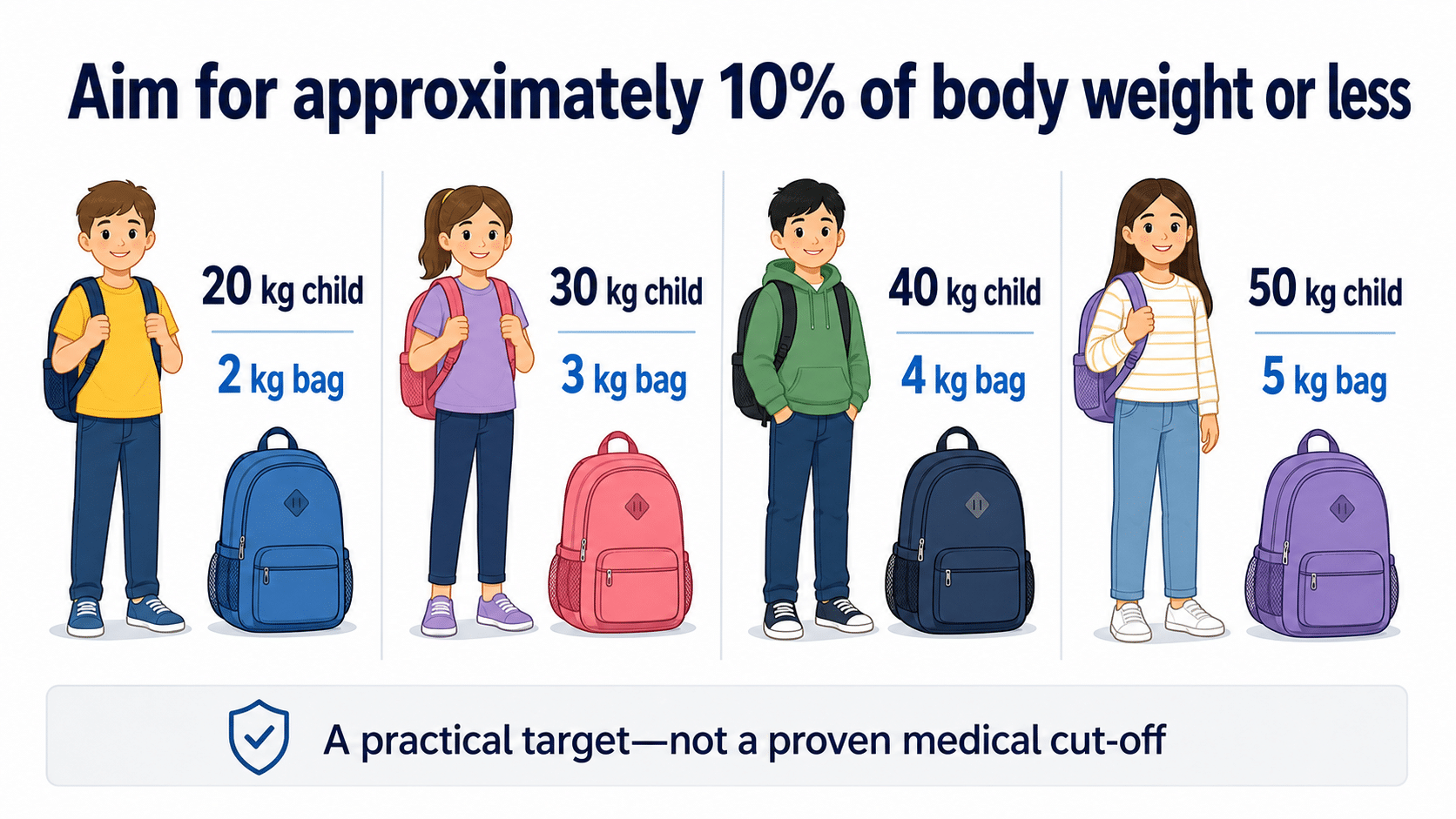
As a simple, conservative target, try to keep the fully loaded school bag at or below 10% of your child’s body weight. A child who weighs 30 kg, for example, would have a suggested bag target of approximately 3 kg.
The 10% figure is a practical rule of thumb, not a scientifically proven boundary between ‘safe’ and ‘unsafe’. Children differ in size, strength, fitness, health and the distance they walk. How your child feels and moves while carrying the bag is therefore just as important as the number on the scales.
If your child struggles to lift the bag, leans forward under its weight or develops discomfort, the load needs attention even when it falls below 10%
School-bag weight guide
Use the table as a quick reference. Weigh the bag as it is genuinely carried, including the water bottle, lunch, laptop and PE kit. Place the packed bag directly on a bathroom or luggage scale. If that is not practical, weigh your child without the bag and then while holding it; the difference is the bag’s approximate weight.
| Child’s body weight | Approximate 10% bag target |
|---|---|
| 20 kg | 2 kg |
| 25 kg | 2.5 kg |
| 30 kg | 3 kg |
| 35 kg | 3.5 kg |
| 40 kg | 4 kg |
| 45 kg | 4.5 kg |
| 50 kg | 5 kg |
| 55 kg | 5.5 kg |
| 60 kg | 6 kg |
What does the research say about heavy school bags?
The evidence is more nuanced than some back-to-school warnings suggest. Carrying a heavy bag creates an additional load for the body to manage, and research shows that a loaded backpack can temporarily affect posture, walking speed and stride length. That is not the same as proving permanent spinal damage.
A 2018 systematic review found that bag weight, design and carrying method had not been shown in prospective studies to increase the risk of children subsequently developing back pain.
A separate 2019 systematic review and meta-analysis did not find an association between bags weighing at least 10% of body weight and low-back pain.
A 2023 review of backpack biomechanics found changes in aspects of posture and walking, although almost all the measured changes were not directly related to the percentage of body weight carried.
This does not make bag weight irrelevant. An overloaded bag can still be tiring, awkward and uncomfortable. It simply means that no single percentage predicts which child will experience pain. A 10% target, sensible packing and attention to the child’s own response make a more useful combination than treating one number as an absolute rule
How should a school bag fit?
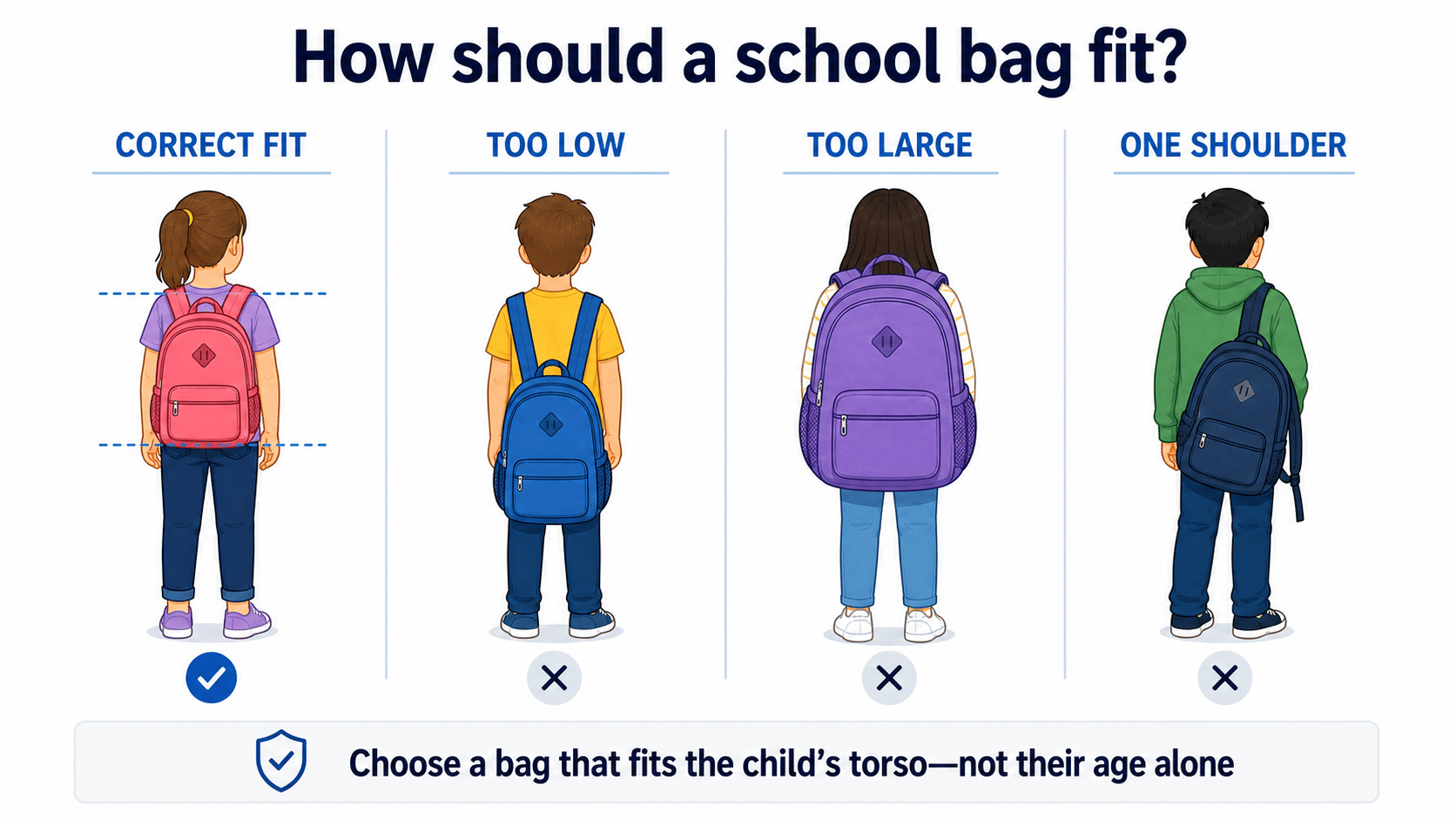
Choose the size according to the child’s body rather than their age. Two children in the same school year may need very different bags
When trying on a bag, check that:
- It is no wider than the child’s torso.
- It sits close to the body without a large gap.
- The top does not push into the neck or extend significantly above the shoulders.
- The bottom rests around or just above the waist rather than hanging towards the buttocks.
- The straps remain securely on the shoulders.
- The child can stand and walk normally without leaning noticeably forward or backward.
- The bag does not swing excessively from side to side.
Try the bag with a representative load inside. A bag that fits well when empty can behave very differently once books, a laptop and a full water bottle have been added.
The German Social Accident Insurance organisation recommends trying a school bag with both lighter clothing and a thicker coat, and readjusting it as the child grows. See the DGUV school-bag guidance.
What features should parents look for
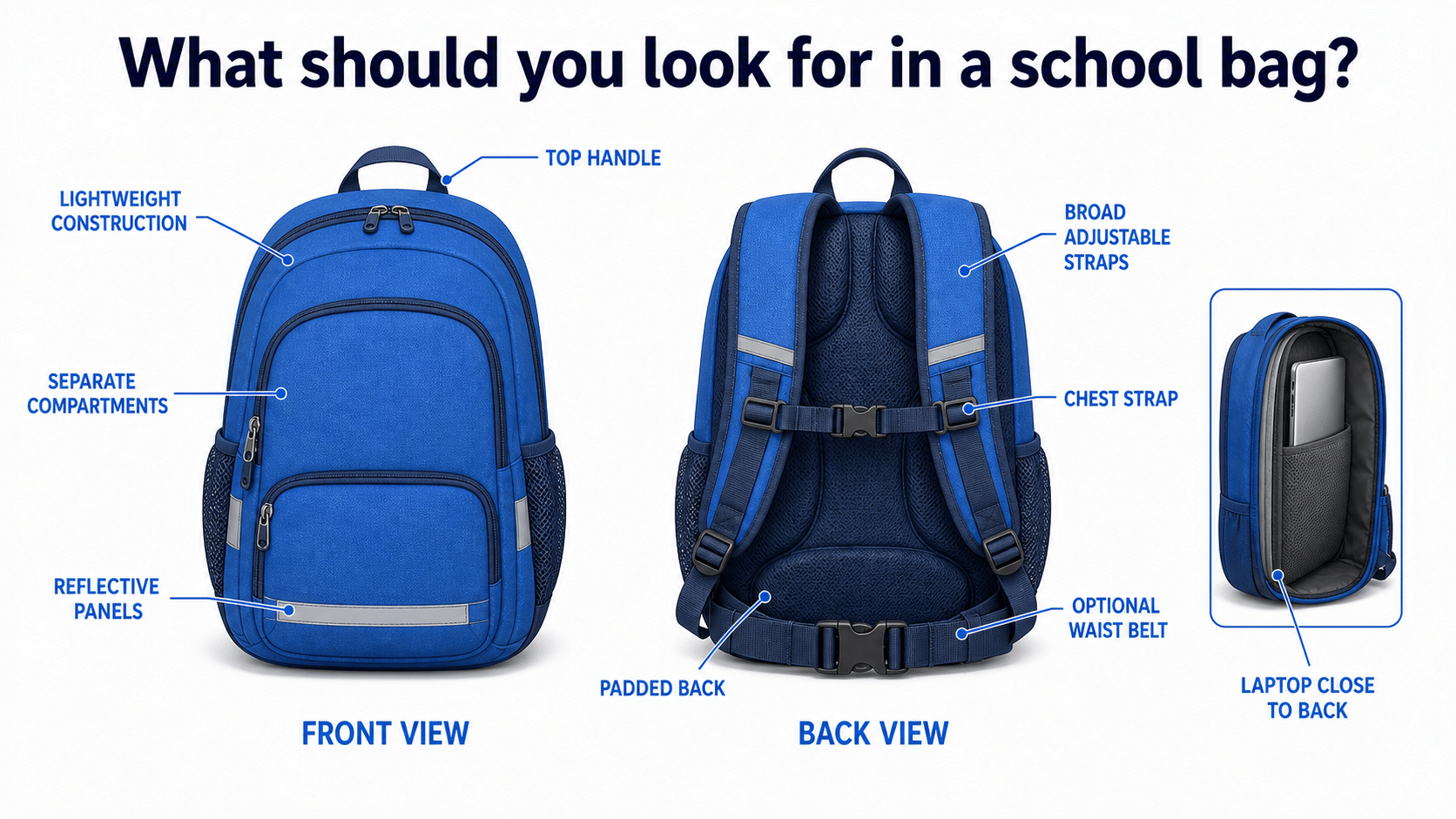
A lightweight starting point
Check the empty bag before buying it. A heavily structured bag may use a meaningful part of the child’s suggested allowance before anything has been packed.
Two broad, adjustable shoulder straps
For most children, a rucksack-style bag distributes the load more evenly than a bag routinely carried on one shoulder. The straps should be broad, comfortable, adjustable and set to approximately equal lengths. Tighten them enough to hold the load close to the body, and encourage your child to use both straps.
A chest strap or waist belt
A chest strap helps stop the shoulder straps slipping and reduces movement. A correctly positioned waist belt may also stabilise a heavier load. These features can be particularly helpful on a longer walk, but they do not make an excessively heavy bag appropriate.
A padded back
Back padding can improve comfort and protect against sharp corners inside the bag. More padding does not automatically mean more protection, so it should not substitute for good fit and sensible weight.
Useful compartments
Compartments reduce movement and make it easier to keep heavier items close to the body. A laptop or tablet should sit securely in a compartment next to the back rather than pulling from the outermost part of the bag.
Reflective and fluorescent material
Children travelling during darker mornings and afternoons need to be visible. Reflective strips show up in headlights, while fluorescent panels help in daylight and lower light. Reflective stickers, tags or a suitable cover can be added if the bag has few visibility features.
See Transport for London’s Brighten Your Bag guidance for a practical UK example.
A secure top handle
A top handle is useful for hanging the bag and lifting it into position. It may suit very short carries, but a loaded bag should not routinely be carried in one hand.
How to pack a school bag properly
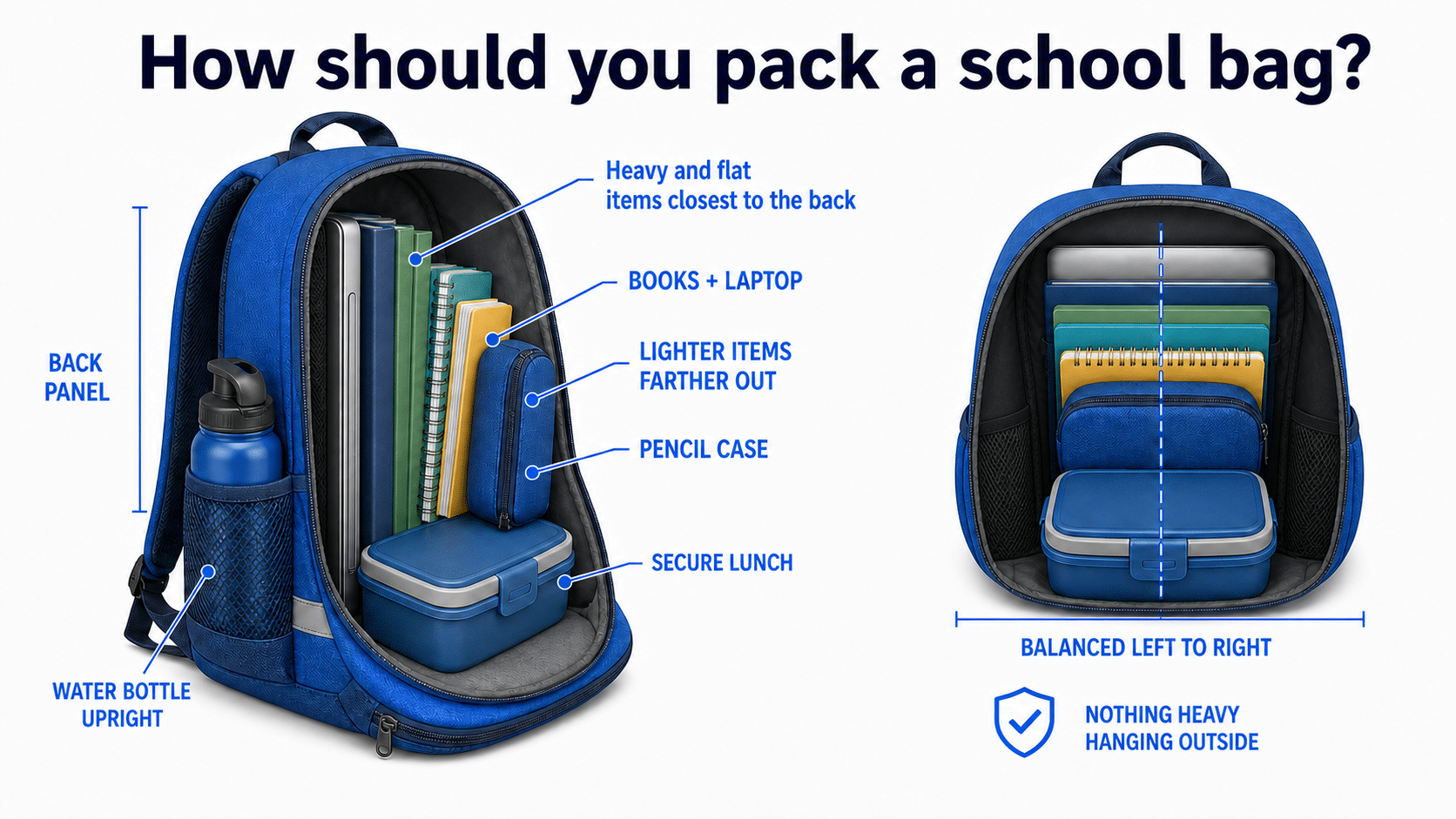
Good packing keeps the densest part of the load close to the child and prevents the contents from shifting unnecessarily
A simple packing routine is to:
- Place books, laptops and other dense items closest to the back panel.
- Balance the contents between the left and right sides.
- Use compartments so that objects do not move around.
- Keep sharp or awkwardly shaped objects away from the child’s back.
- Secure the water bottle and check it cannot leak.
- Remove books, folders and equipment that are not needed that day.
- Avoid attaching heavy items to the outside of the bag.
A heavy object in the outermost compartment creates more leverage and may make the bag feel harder to control. Bringing it closer to the body normally makes the load easier to manage.
How to lift and put on a school bag
Children should avoid twisting or forcefully swinging a heavy bag onto one shoulder.
- Place the bag on a stable surface at about waist height where possible.
- Face it and use both hands.
- If lifting from the floor, bend the knees and keep the bag close.
- Put on one strap and then the other without a forceful twist.
- Fasten and adjust the chest or waist strap if fitted.
This is consistent with guidance from the UK Association of Paediatric Chartered Physiotherapists and the American Academy of Pediatrics.
Practical ways to lighten the load
A better bag cannot solve the problem if the child is still expected to carry too much. The most effective change is often deciding what genuinely needs to travel.
- Check the next day’s timetable each evening.
- Clear the bag out completely once a week.
- Remove old worksheets, food packaging and excess stationery.
- Use lockers or classroom storage where available.
- Ask whether textbooks can remain at school.
- Ask about a second set of frequently used books or digital access.
- Carry sports equipment only on the days it is required.
- Avoid duplicate chargers and ‘just in case’ items.
- Discuss a persistently heavy bag with the teacher or school.
School bags frequently accumulate material without anyone noticing. A regular ten-minute clear-out can make a bigger difference than buying a more technical backpack
What about water bottles?
Children need reliable access to drinking water, so hydration should not be reduced simply to meet a weight target. Where safe water is available and the school allows refilling, a child can carry what is needed for the journey and early part of the day, then refill the bottle at school.
One litre of water weighs approximately one kilogram. For a younger child, an unnecessarily large full bottle may account for a substantial part of the bag’s total weight. Choose a secure, leak-resistant bottle of an appropriate size and position it so that it does not pull the bag noticeably to one side.
Walking, cycling and travelling by car
Walking to school
Carrying time matters. A bag may feel manageable for five minutes but uncomfortable over a long walk, particularly on hills or when combined with a separate sports bag. Footwear, weather and the child’s fitness also affect the overall demand.
Cycling to school
A basket or pannier may be preferable if a backpack moves around or affects balance. Any bag worn while cycling should be stable and should not obstruct movement or visibility.
Travelling by car or bus
Children should remove a bulky backpack in a vehicle so that the seat belt can lie correctly against the body. Store the bag securely rather than leaving it loose where it could move during sudden braking.
Are rolling school bags better?
A rolling bag may help in particular circumstances, but it is not automatically the better choice. Stairs, kerbs, crowded corridors and repeatedly pulling with one arm can create practical difficulties. Check the school’s rules and the child’s normal route before buying one
Signs that a school bag may be too heavy or poorly fitted
Recheck the bag if your child:
- Leans forward or changes posture while wearing it.
- Walks differently or appears less steady.
- Struggles to put the bag on or take it off.
- Complains of pain around the neck, shoulders or back.
- Develops persistent red marks beneath the straps.
- Reports tingling or numbness.
- Finds that the straps dig into the shoulders.
- Regularly describes the bag as uncomfortable or too heavy.
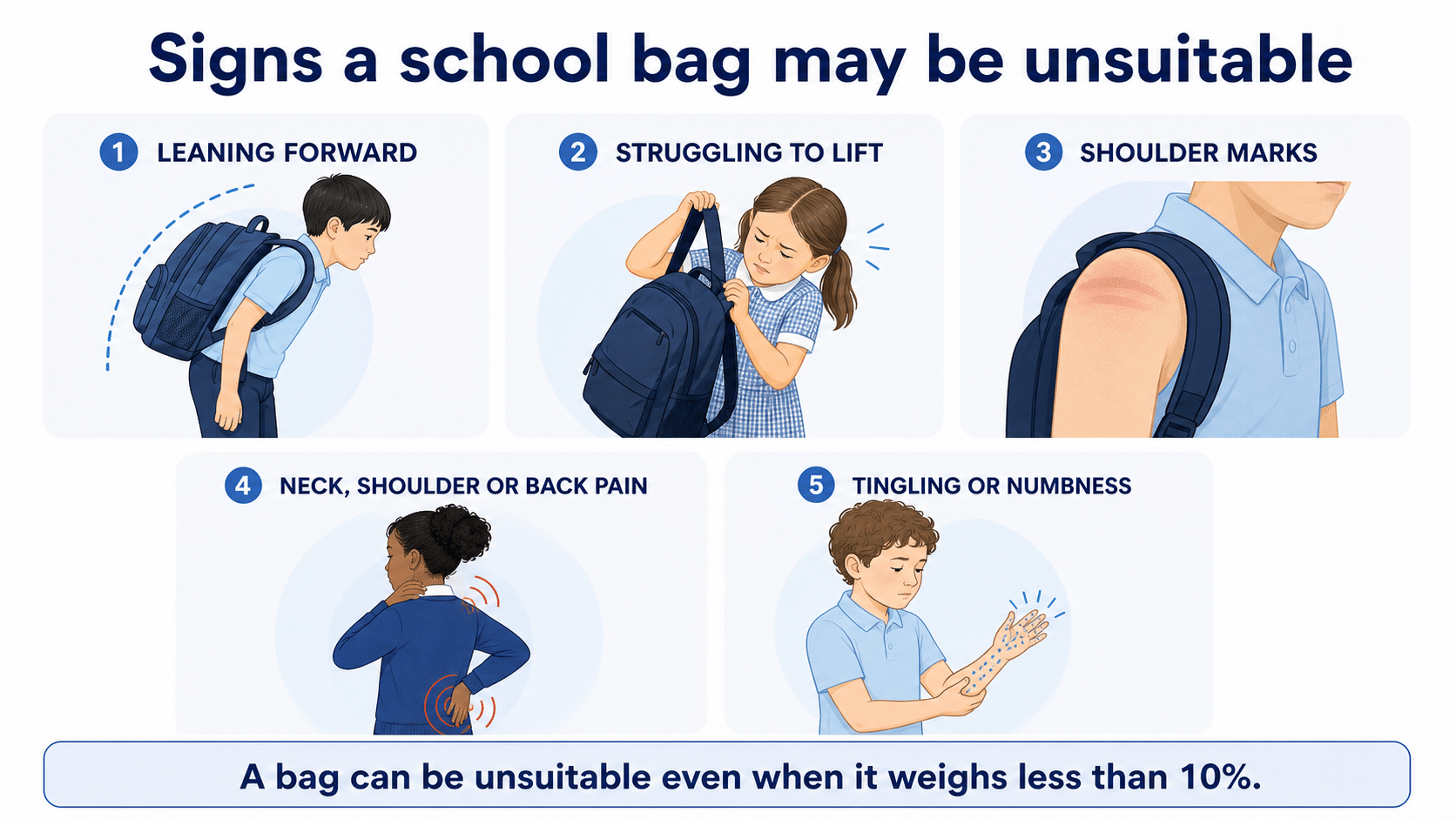
School-bag checklist for parents
When should back pain be assessed?
Back pain should not automatically be blamed on the school bag. Pain in children and teenagers can have many causes, including activity, injury, illness and other health conditions. Seek appropriate professional advice when pain persists, worsens or interferes with normal activities.
Prompt medical assessment is particularly important when back pain is accompanied by:
- Fever or feeling generally unwell.
- Unexplained weight loss.
- Pain at night or at rest.
- Weakness, tingling or numbness.
- Pain spreading into one or both legs.
- Difficulty walking.
- Changes in bladder or bowel control.
- A significant fall, collision or other injury.
- Severe pain in a child under six.
These warning signs are described in NHS guidance on back pain in children.
When should back pain be assessed?
Back pain should not automatically be blamed on the school bag. Pain in children and teenagers can have many causes, including activity, injury, illness and other health conditions. Seek appropriate professional advice when pain persists, worsens or interferes with normal activities.
Prompt medical assessment is particularly important when back pain is accompanied by:
- Fever or feeling generally unwell.
- Unexplained weight loss.
- Pain at night or at rest.
- Weakness, tingling or numbness.
- Pain spreading into one or both legs.
- Difficulty walking.
- Changes in bladder or bowel control.
- A significant fall, collision or other injury.
- Severe pain in a child under six.
These warning signs are described in NHS guidance on back pain in children.
Frequently Asked Questions
Ten per cent is a useful conservative target. Some organisations use a limit of up to 15%, but research has not established a universal threshold. Comfort, carrying time, health and movement also matter.
No. It is a practical precaution rather than a proven point at which injury begins. Systematic reviews have not shown that exceeding exactly 10% causes back pain. It remains a useful prompt to identify and reduce unnecessary weight.
For most children, a lightweight rucksack with two broad adjustable straps is the most practical choice. A chest strap, waist belt, padded back, secure compartments and reflective material may also be useful.
Yes. Both straps help distribute the load and stabilise the bag. Adjust them to similar lengths so the bag sits close to the body.
It should rest close to the middle of the back, with the bottom around or just above the waist. It should not hang towards the buttocks or extend significantly above the shoulders.
A heavy bag can contribute to discomfort, fatigue and temporary changes in posture or walking. Current evidence does not show that a particular bag weight permanently damages an otherwise healthy growing spine, so claims about inevitable structural damage should be treated cautiously.
No. Heavy bags and poor posture have not been shown to cause scoliosis. A badly fitted bag may be uncomfortable, but it does not create a structural spinal curve.
Only if safe drinking water is readily available and the school permits refilling. Children must remain adequately hydrated. A smaller refillable bottle may be a better answer than either a very large full bottle or no water.
Seek advice if pain persists, worsens, interferes with normal activities or occurs away from carrying the bag. Fever, night pain, unexplained weight loss, weakness, numbness, difficulty walking or bladder and bowel changes require medical assessment.
The key message
There is no perfect school bag and no single weight limit that suits every child. The most useful approach is to combine a conservative weight target with a bag that fits, sensible packing and attention to how the child actually feels.
- Aim for a loaded weight of around 10% of body weight or less.
- Choose a lightweight bag that fits the child’s torso.
- Use both shoulder straps and keep the bag close to the body.
- Pack the heaviest items nearest the back.
- Remove unnecessary contents regularly.
- Act on discomfort, altered walking or difficulty lifting the bag.
- Speak to the school when the required daily load is consistently excessive.
A few small adjustments can make the daily journey to school much more comfortable and manageable.
This article provides general information and is not a substitute for individual medical advice. Seek advice from an appropriate healthcare professional if you are concerned about your child’s symptoms or ability to carry their school bag.
Concerned about your child’s symptoms?
If your child has persistent or worsening pain, changes in the way they walk, weakness, tingling or numbness, seek advice from an appropriate healthcare professional.
For a non-urgent discussion about whether an assessment at Morningside Chiropractic may be appropriate, please contact our clinic team.