

Frozen Shoulder Symptoms, Stages and the Conditions Most Commonly Mistaken for Adhesive Capsulitis
“I think I’ve got a frozen shoulder.”
It’s one of the most common things we hear from new patients attending our clinic in Edinburgh.
Sometimes they’re right.
But surprisingly often, they’re not.
In fact, one of the most common misconceptions we encounter is the belief that any painful, stiff shoulder must be a frozen shoulder. While adhesive capsulitis is certainly a real and often frustrating condition, many people who believe they have a frozen shoulder are actually dealing with something entirely different.
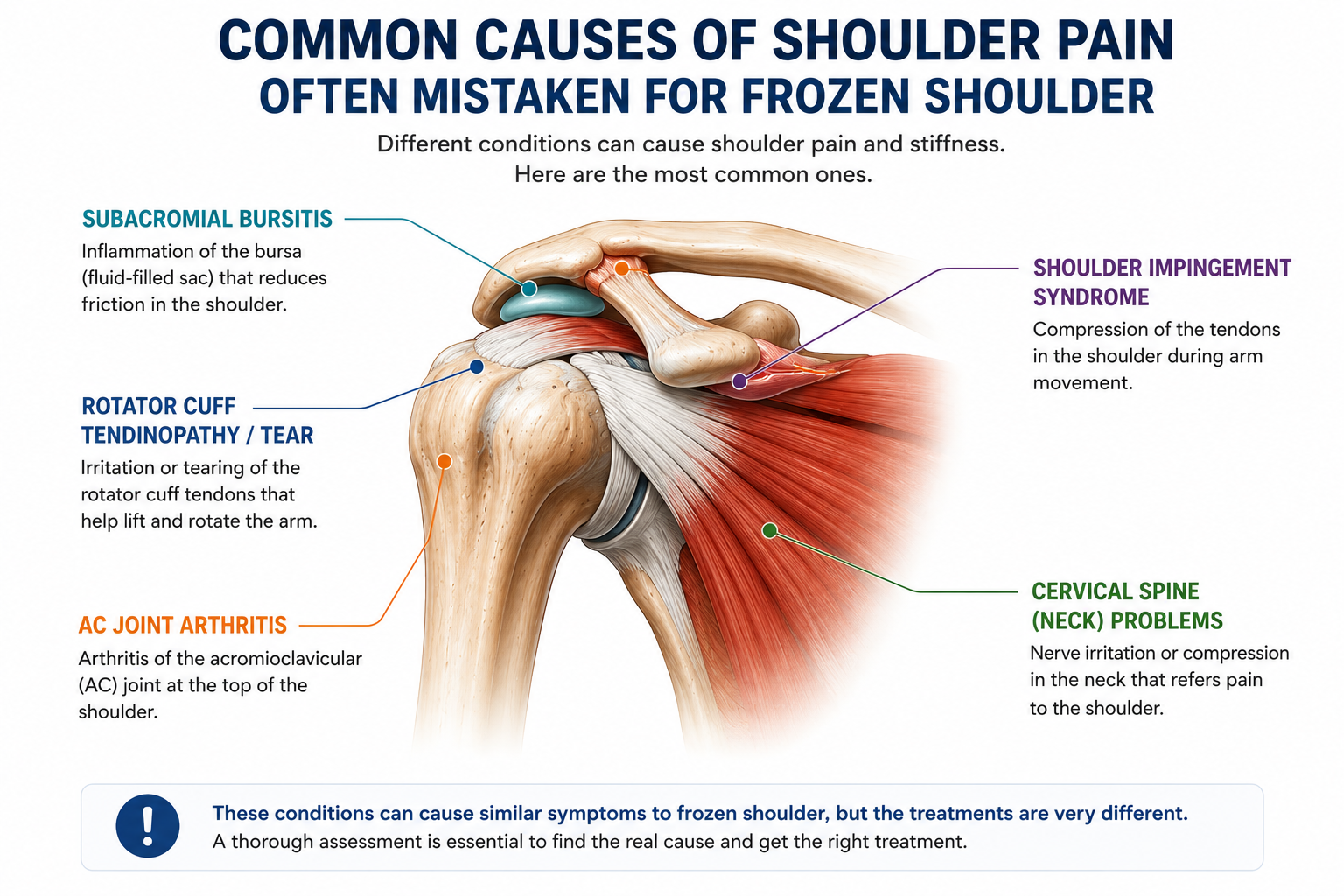
Rotator cuff injuries, bursitis, shoulder impingement, acromioclavicular (AC) joint irritation and even problems originating from the neck can all produce symptoms that look remarkably similar in the early stages.
This matters because each condition behaves differently, recovers differently and may respond to different treatment approaches.
At Morningside Chiropractic in Edinburgh, a significant proportion of patients who arrive convinced they have frozen shoulder ultimately receive a different diagnosis following a thorough examination.
In this article we’ll explain:
- What frozen shoulder actually is
- The three stages of adhesive capsulitis
- The key signs that help distinguish it from other shoulder conditions
- The most common problems mistaken for frozen shoulder
- When to seek professional assessment
If you’re struggling with shoulder pain or stiffness and wondering whether frozen shoulder is really the cause, this guide should help.
Quick Answer: Does Your Shoulder Sound Like a Frozen Shoulder
These signs aren’t diagnostic on their own, but they provide useful clues.
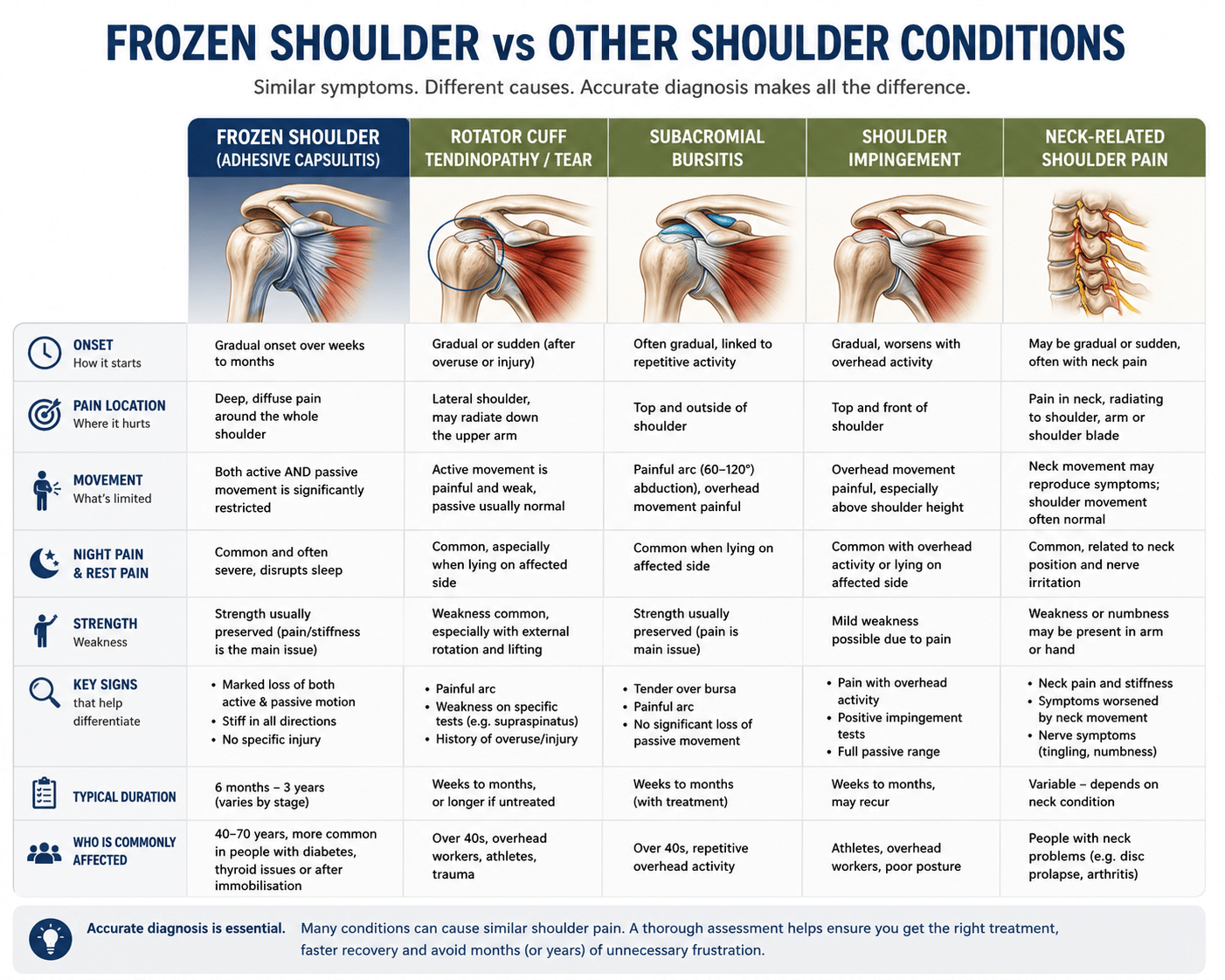
Signs It May Be Frozen Shoulder
✓ Gradual onset without a specific injury
✓ Increasing stiffness over several months
✓ Pain that is often worse at night
✓ Difficulty moving the shoulder in almost every direction
✓ Someone else cannot move your arm much further than you can
✓ Age between 40 and 65
✓ History of diabetes or thyroid problems
Signs It Might Be Something Else
✓ Pain started after a specific injury
✓ Only certain movements are painful
✓ Significant weakness when lifting the arm
✓ Someone else can move your shoulder much further than you can
✓ Pain radiates below the elbow or into the hand
✓ Tingling or numbness in the arm
What Is Frozen Shoulder
Frozen shoulder, also known as adhesive capsulitis, is a condition affecting the capsule that surrounds the shoulder joint.
The shoulder capsule is a sleeve of connective tissue that helps stabilise the ball-and-socket joint. In frozen shoulder, this capsule becomes inflamed, thickened and contracted.
As the capsule tightens, movement becomes progressively restricted. The hallmark feature of a true frozen shoulder is not simply pain.
It is pain combined with a substantial loss of movement in virtually every direction.
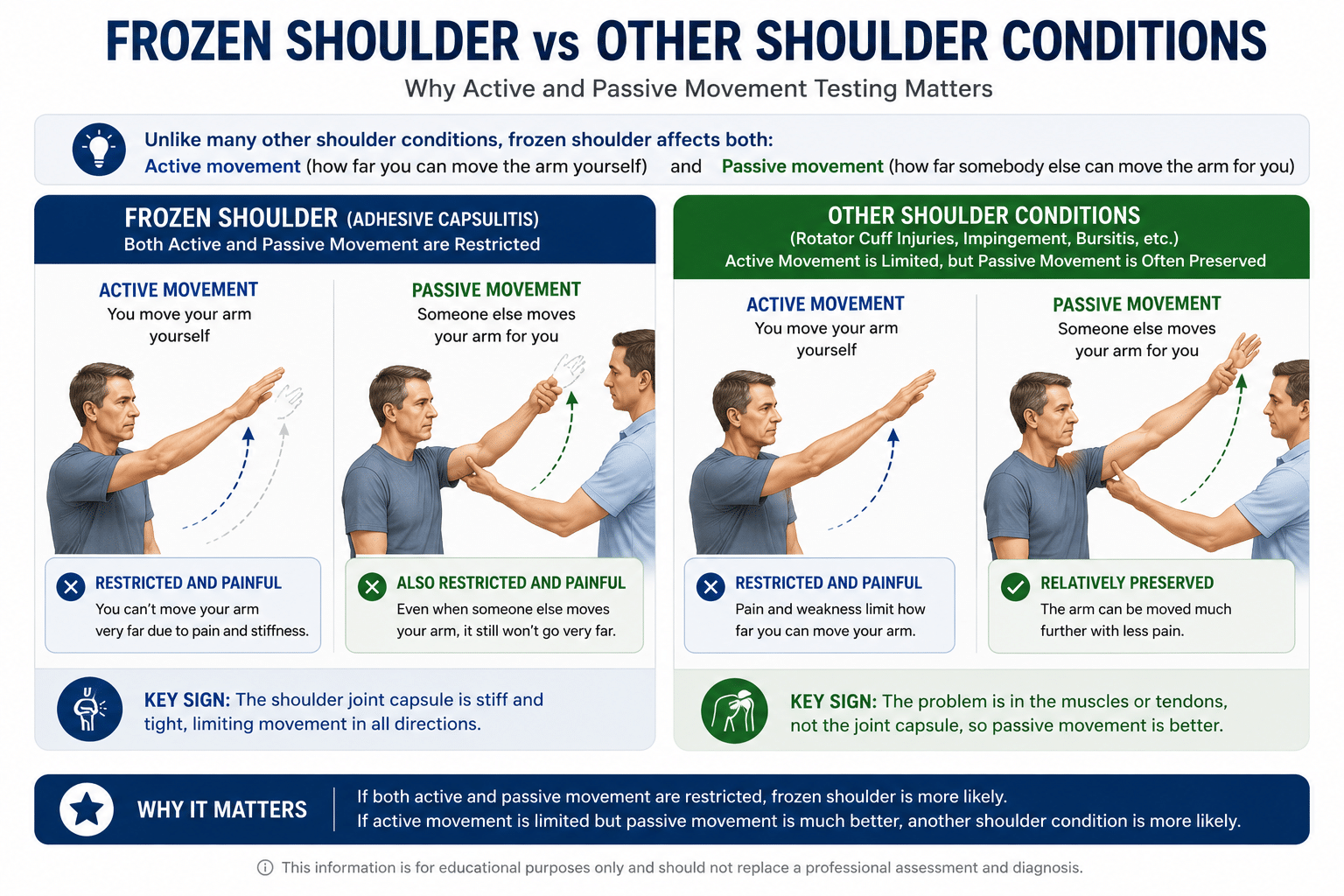
Unlike many other shoulder conditions, frozen shoulder affects both:
- Active movement (how far you can move the arm yourself)
- Passive movement (how far somebody else can move the arm for you)
This distinction becomes extremely important when making a diagnosis
How Common Is Frozen Shoulder
Frozen shoulder is often talked about as though it’s one of the most common shoulder conditions.
In reality, estimates suggest it affects around 2–5% of the general population.
The risk increases significantly in people with:
- Diabetes
- Thyroid disorders
- Previous shoulder trauma
- Previous shoulder surgery
- Certain cardiovascular conditions
It most commonly affects people between the ages of 40 and 65.
Women appear to be affected slightly more frequently than men
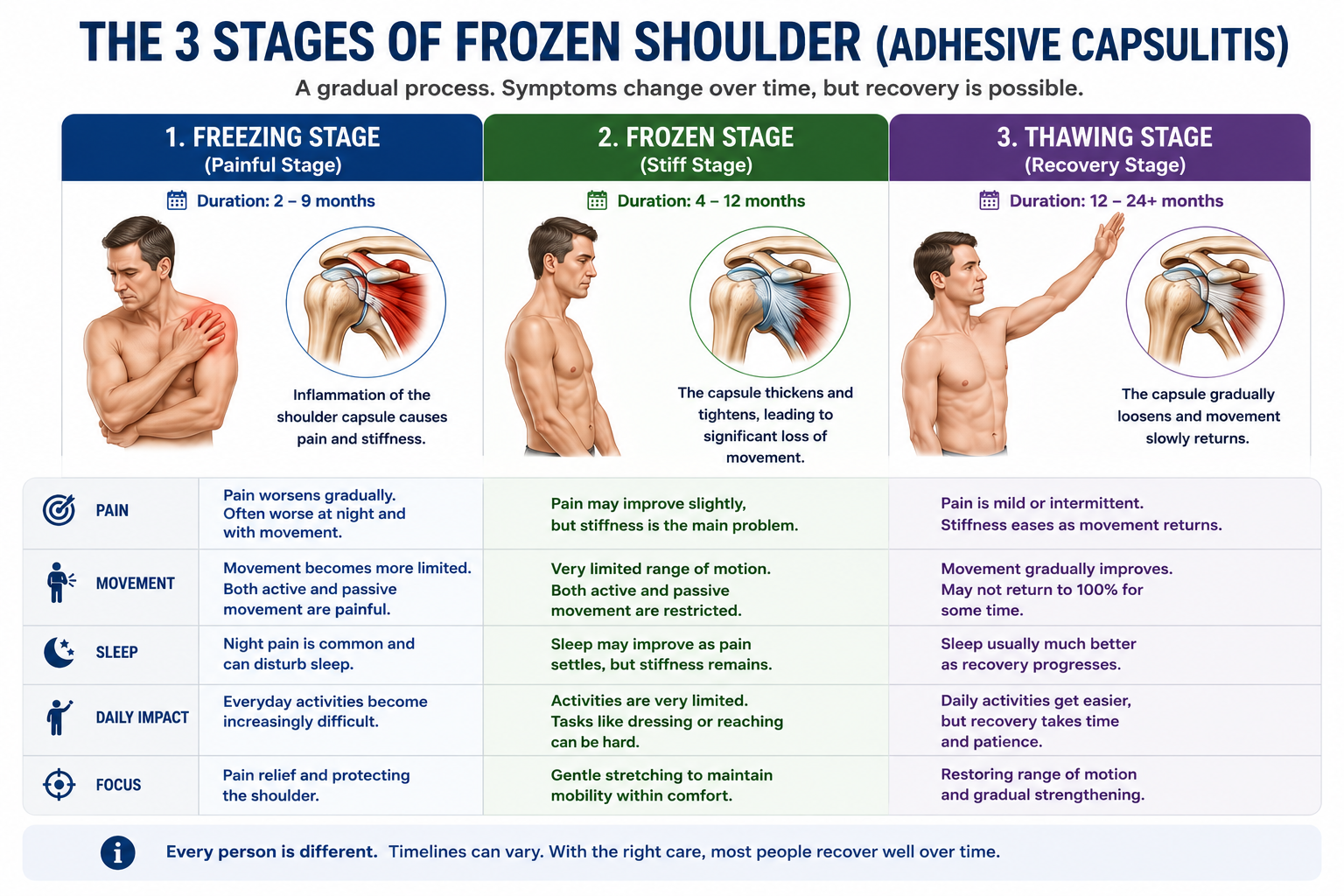
The Three Stages of Frozen Shoulder
One of the characteristics that makes adhesive capsulitis unique is that it typically progresses through three distinct phases.
Stage 1: Freezing Phase (2–9 Months)
This is usually the most painful stage.
Common symptoms include:
- Gradually worsening shoulder pain
- Night pain
- Difficulty sleeping on the affected side
- Early loss of movement
- Increasing difficulty reaching behind your back or putting on a coat
This stage is commonly mistaken for rotator cuff problems or bursitis.
Stage 2: Frozen Phase (4–12 Months)
Pain often begins to settle.
Unfortunately, stiffness becomes much more noticeable.
People frequently struggle with:
- Reaching overhead
- Fastening a bra
- Putting on a jacket
- Washing their hair
- Reaching into back pockets
Movement is restricted in almost every direction.
Stage 3: Thawing Phase (5–26 Months)
Gradually the capsule begins to loosen.
Movement slowly returns.
Pain reduces significantly.
Many people recover most of their movement, although some may retain a small degree of stiffness.
Overall recovery may take anywhere from 8 months to 3 years.
The Most Important Test: Active vs Passive Movement
When assessing a shoulder, one of the most useful clinical observations is the difference between active and passive movement.
Active Movement
How far you can move your own arm.
Passive Movement
How far someone else can move the arm while you remain relaxed.
In a true frozen shoulder:
Both active and passive movement are restricted.
The capsule itself is physically tight.
In many other shoulder conditions:
Active movement is restricted but passive movement is much better preserved.
This is often one of the key clues that we’re not dealing with adhesive capsulitis.
Conditions Commonly Mistaken for Frozen Shoulder
Rotator Cuff Injuries
Rotator cuff injuries are one of the most common shoulder problems we see.
Symptoms may include:
- Pain lifting the arm
- Weakness
- Night pain
- Difficulty reaching overhead
Unlike frozen shoulder, passive movement is often much better preserved.
Subacromial Bursitis
Inflammation of the bursa can produce:
- Severe shoulder pain
- Painful lifting
- Night pain
- Restricted movement due to pain
The symptoms can look remarkably similar to the early stages of frozen shoulder.
Shoulder Impingement
This occurs when structures within the shoulder become irritated during movement.
Typically:
- Certain movements hurt
- Stiffness is limited
- Movement remains available even if painful
This differs from the global restriction seen in adhesive capsulitis.
AC Joint Problems
The acromioclavicular joint sits at the top of the shoulder.
Pain is often:
- Localised to the top of the shoulder
- Worse when reaching across the body
- Triggered by pressure directly over the join
Neck-Related Shoulder Pain
Not all shoulder pain originates from the shoulder.
Irritation of nerves in the neck can create symptoms in:
- The shoulder
- Upper arm
- Forearm
- Hand
If symptoms travel below the elbow or involve tingling or numbness, the neck should always be considered.
Can Chiropractic Help?
Whether you have a true frozen shoulder or one of the conditions commonly mistaken for it, the most important first step is obtaining an accurate diagnosis.
At Morningside Chiropractic, our assessment includes:
- Detailed history taking
- Shoulder examination
- Assessment of active and passive movement
- Orthopaedic testing
- Screening of the cervical spine
- Neurological examination when appropriate
For patients with frozen shoulder, treatment often focuses on:
- Managing pain
- improving comfort
- Addressing secondary muscular compensation
- Supporting movement during recovery
For other shoulder conditions such as rotator cuff injuries, bursitis and neck-related shoulder pain, treatment may include manual therapy, rehabilitation advice and targeted exercise programmes where appropriate.
When Should You Seek Help?
Consider professional assessment if:
- Shoulder pain has persisted for more than two weeks
- Symptoms are affecting sleep
- Movement is becoming progressively restricted
- You are unsure whether it is truly frozen shoulder
- Pain extends into the arm or hand
- You have significant weakness
Book a Shoulder Assessment in Edinburgh
If you’re struggling with shoulder pain or stiffness and aren’t sure whether you’re dealing with a frozen shoulder, we’d be happy to help.
Our team of five GCC-registered chiropractors has over 75 years of combined clinical experience assessing shoulder conditions across Edinburgh.
Call 0131 447 3794 or visit our Shoulder Pain page to learn more about how we assess and treat shoulder problems.
About the Author
Alan Cavanagh DC is the owner and principal chiropractor at Morningside Chiropractic, Edinburgh. He graduated from the Welsh Institute of Chiropractic in 2002 and has been helping patients with musculoskeletal conditions, sports injuries and spinal pain for over 20 years.
References
- NHS Inform – Frozen Shoulder (Adhesive Capsulitis)
- NICE Clinical Knowledge Summaries – Shoulder Pain
- British Elbow and Shoulder Society (BESS)
- NHS England – Frozen Shoulder Overview
Related Reading
- Shoulder Pain Treatment in Edinburgh
- Neck Pain Treatment in Edinburgh
- Sports Injuries in Edinburgh
- Rotator Cuff Injuries (Coming Soon)