

Enjoy your garden — without the setback
As the weather improves and people spend more time in their gardens, we often see a rise in patients presenting with back pain and sciatica triggered by gardening activities.
Gardening is a great way to stay active and enjoy the outdoors, but it also places specific demands on your body. Long periods of bending, lifting, and repetitive movements can quickly lead to irritation in the joints, muscles and nerves of the spine — especially if your body isn’t used to it.
The good news is that most gardening-related injuries are preventable with a few simple changes.
Why gardening can lead to back pain
Gardening combines several movements that can place strain on your lower back, including:
- Prolonged bending or stooping
- Repetitive digging or weeding
- Twisting while lifting or carrying
- Working at ground level for extended periods
This is particularly common in spring, when many people have spent months being relatively inactive over winter and then launch into a full day of gardening. After a period of reduced activity, your muscles, joints and soft tissues lose some of their conditioning and become less tolerant of sustained load. A sudden increase in gardening — even moderate activity — can easily tip the balance and cause strain or injury.
Common gardening problems and what causes them
| Common Issue | Typical Cause | What You Might Feel |
|---|---|---|
| Lower back pain | Bending, lifting, prolonged stooping | Ache, stiffness, sharp pain |
| Sciatica | Nerve irritation from lifting or bending | Pain into buttock or leg |
| Shoulder strain | Reaching, digging | Pain when lifting the arm |
| Wrist/hand strain | Repetitive tool use | Weakness, tingling |
Common gardening mistakes that lead to injury
Most problems don’t come from one single movement, but from repeated habits over time. Small strains can build gradually, especially when the same position or movement is repeated for longer than your body is used to.
Bending from the spine instead of the hips
Many people naturally bend forward through their lower back when gardening, particularly when weeding or planting. Repeating this movement places unnecessary strain on the joints and discs of the spine. Bending from your hips instead helps distribute the load more evenly and reduces stress on your lower back.
Staying in one position too long
It’s easy to lose track of time when focused on a task like weeding or pruning. However, staying in the same position for extended periods can overload muscles and joints, leading to stiffness and discomfort. Changing position regularly helps keep your body moving and reduces the build-up of tension.
Sudden heavy lifting
Lifting compost bags, pots, or paving stones without preparation is a common trigger for back pain. The risk increases when lifting is combined with twisting or awkward positioning. Taking a moment to set your position and lift correctly can make a significant difference.
Doing too much in one session
Trying to complete everything in a single day is one of the most common causes of flare-ups. A sudden increase in activity, especially after a quieter period, can overload the body and lead to pain the following day. Gradually building up your activity is far more effective and sustainable.
Sticking to one task without switching
Repeating the same movement — such as weeding the same bed for an extended period — concentrates load on the same muscles and joints. Rotating between different tasks (for example, weeding for 15 minutes, then standing to prune or sweep) naturally varies your body position and reduces the risk of overloading any one area.
Simple ways to protect your back while gardening
You don’t need to avoid gardening — just approach it more gradually and efficiently. A few simple adjustments to how you work can significantly reduce the risk of pain and help you stay active for longer.
Warm up before you start
Gardening is a form of physical activity, so it makes sense to prepare your body before starting. A short walk, some gentle stretches, or a few minutes of movement can help increase blood flow and reduce the risk of strain.
Pace your workload
Rather than tackling everything at once, start with lighter tasks and gradually build up to more demanding activities. This gives your body time to adapt and reduces the likelihood of overloading muscles and joints.
Take regular breaks
Changing position every 20–30 minutes helps prevent stiffness and fatigue. Even a short break to stand upright, walk around, or stretch can make a noticeable difference, particularly during longer gardening sessions.
Work in timed blocks rather than “until the job is done”
One of the most common causes of gardening-related back pain is simply doing too much in one go. It’s easy to start a task with the intention of “just finishing this section”, only to spend much longer than planned in the same position.
A more effective approach is to work in timed blocks rather than by task completion. Setting a timer on your phone for 20–30 minutes can help remind you to stop, change position, and take a short break.
This reduces the risk of overloading the same muscles and joints, particularly in the lower back, and helps prevent stiffness building up without you realising. This is especially important if you have previously experienced back pain or sciatica.
Even a short break to stand upright, walk around, or switch to a different activity can make a significant difference over the course of a longer gardening session.
Use better positioning
- Bend from your hips rather than your lower back
- Keep tasks close to your body
- Avoid overreaching
Poor vs correct posture when weeding
Posture during low-level tasks like weeding is one of the most common causes of back strain, particularly when bending repeatedly through the lower spine.
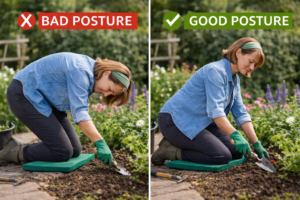
- Bend from your hips rather than your lower back
- Keep tasks close to your body
- Avoid overreaching
Adapt your setup
- Use kneeling pads or a garden stool
- Consider raised beds or planters
- Use long-handled tools where possible
Consider vertical gardening methods — trellises, wall-mounted planters, or tiered raised beds can keep plants at a more comfortable working height, reducing the need to stoop or kneel repeatedly.
It’s also important to consider the size and length of the tools you’re using. Many standard garden tools are not well suited to taller individuals, which can encourage more bending through the back. Choosing longer-handled tools, or adapting your setup so you can work at a more comfortable distance and height, can help reduce unnecessary strain — particularly during tasks like digging or weeding where posture is sustained.
Use equipment to reduce lifting
A wheelbarrow or garden cart is one of the most effective tools for protecting your back. Rather than carrying heavy bags of compost, soil or mulch, use a wheelbarrow to move them — this significantly reduces the sustained load placed on your spine. The same applies to large plant pots; wherever possible, move them on a wheeled platform rather than lifting them directly.
Guidance from the British Chiropractic Association highlights the importance of pacing activity and avoiding sudden increases in workload when undertaking physical tasks such as gardening.
Lifting and digging: small changes that make a big difference
Many gardening injuries occur during lifting.
Poor vs correct digging technique
Digging and lifting are higher-load movements where technique becomes even more important, especially when combined with twisting or prolonged effort.
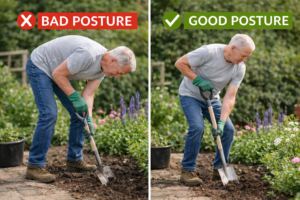
Golden rule: Bend your knees, not your back
When lifting or digging:
- Keep your feet shoulder-width apart
- Bend through your hips and knees
- Keep objects close to your body
- Avoid twisting — turn with your feet instead
- Use your body weight rather than just your arms when digging
These small adjustments can significantly reduce strain on your spine.
Can gardening cause sciatica?
Yes — gardening can sometimes trigger sciatica, particularly when the sciatic nerve becomes irritated.
This may present as:
- Pain travelling into the buttock or leg
- Pins and needles or numbness
- Symptoms that worsen with sitting, bending or lifting
Sciatica is not a diagnosis but a pattern of symptoms, and it can have a number of underlying causes. This is why symptoms can sometimes appear in the leg even when the problem starts in the lower back
The role of core strength in preventing gardening injuries
How well your body copes with the demands of gardening depends partly on your general physical conditioning — particularly the strength and endurance of the muscles that support your spine. People with stronger core muscles tend to tolerate sustained bending, digging and lifting more comfortably, and are less likely to develop problems after a longer gardening session.
This doesn’t mean you need to follow a demanding exercise programme. Simple exercises that improve spinal stability — such as those recommended by a chiropractor as part of a management plan — can make a meaningful difference to how your body manages physical activity like gardening.
If you’ve experienced repeated episodes of back pain related to gardening, this may be worth discussing at your next appointment
What to do if your back hurts after gardening
A small amount of muscle soreness after a day in the garden is normal, particularly if you’ve done more than usual. This typically settles within 24–48 hours with gentle movement, rest when needed, and over-the-counter pain relief if appropriate.
According to guidance from the Royal College of Chiropractors, staying gently active and avoiding prolonged rest is one of the most effective ways to support recovery from back pain.
However, if symptoms are more significant, the following can help in the first day or two:
- Keep moving gently — avoid complete rest where possible, as gentle activity helps reduce stiffness
- Apply a heat pack or ice pack to the affected area — whichever feels more comfortable
- Avoid activities that significantly aggravate symptoms in the short term
- Over-the-counter analgesia such as ibuprofen or paracetamol may help manage discomfort
If symptoms don’t improve within a few days, are worsening, or include pain travelling into the leg, it’s worth seeking a professional assessment rather than waiting to see how things settle.
When to seek professional advice
A small amount of stiffness after gardening is normal, but you should seek advice if:
- Pain lasts more than 1–2 weeks
- Symptoms are worsening rather than improving
- Pain is travelling into the leg
- You experience numbness, tingling or weakness
- The same issue keeps recurring
- Early assessment can help identify the cause and prevent longer-term problems.
Frequently Asked Questions
Yes. Gardening involves prolonged bending, lifting, and repetitive movements that place significant demand on the spine and surrounding muscles. It is a common trigger for both acute back pain and flare-ups of existing conditions, particularly in spring when activity levels increase after a quieter winter period.
The most effective steps are: warming up before you start, working in timed blocks of 20–30 minutes with regular breaks, alternating between different tasks, bending from the hips rather than the lower back, using long-handled tools and kneeling pads, and using a wheelbarrow rather than carrying heavy loads directly.
Yes. Sustained bending, lifting with poor technique, or spending long periods crouching can irritate the sciatic nerve, causing pain, pins and needles, or numbness that travels from the lower back into the buttock or leg. If you experience these symptoms after gardening, it’s advisable to seek a professional assessment.
You should seek advice from your regulated musculoskeletal profesional (e.g. Chiropractor, Physiotherapist or Osteopath) if pain lasts more than one to two weeks, if symptoms are worsening rather than improving, if pain is travelling into the leg, or if the same problem keeps recurring season after season. Early assessment helps identify the underlying cause and reduces the risk of the problem becoming chronic.
Yes. Good core strength and spinal stability improve your body’s ability to cope with the sustained demands of gardening. If you experience repeated episodes, a chiropractor can advise on appropriate exercises as part of your care plan.
Enjoy gardening without the pain
Gardening should be something you enjoy, not something that leaves you struggling to move the next day.
By pacing your activity, improving your technique, and making small adjustments to how you work, you can significantly reduce your risk of injury and continue doing what you enjoy.
If gardening has triggered symptoms, you can learn more about how we assess and treat these conditions here:
→ Back Pain Treatment Edinburgh
→ Sciatica Treatment Edinburgh
Our approach follows guidance from the Royal College of Chiropractors on the management of back pain and sciatica, ensuring care is safe, appropriate and evidence-based.
About the author
Alan Cavanagh, BSc (Chiropractic), is a registered chiropractor and member of the Royal College of Chiropractors and British Chiropractic Association. He has over 20 years’ experience helping people in Edinburgh manage back pain, sciatica and other musculoskeletal conditions using evidence-based care aligned with UK clinical guidelines.